School of Technical Analysis
 NEPSE vs Forex, NEPSE or Forex, Forex trading in Nepal, NEPSE trading Nepal, Nepali traders, stock market vs forex, NEPSE investment, forex investment Nepal, NEPSE for beginners, forex for beginners, trading in Nepal, NEPSE trading guide, forex trading guide Nepal, Nepal stock exchange, currency trading Nepal
 0 comment
 12 Jun, 2026
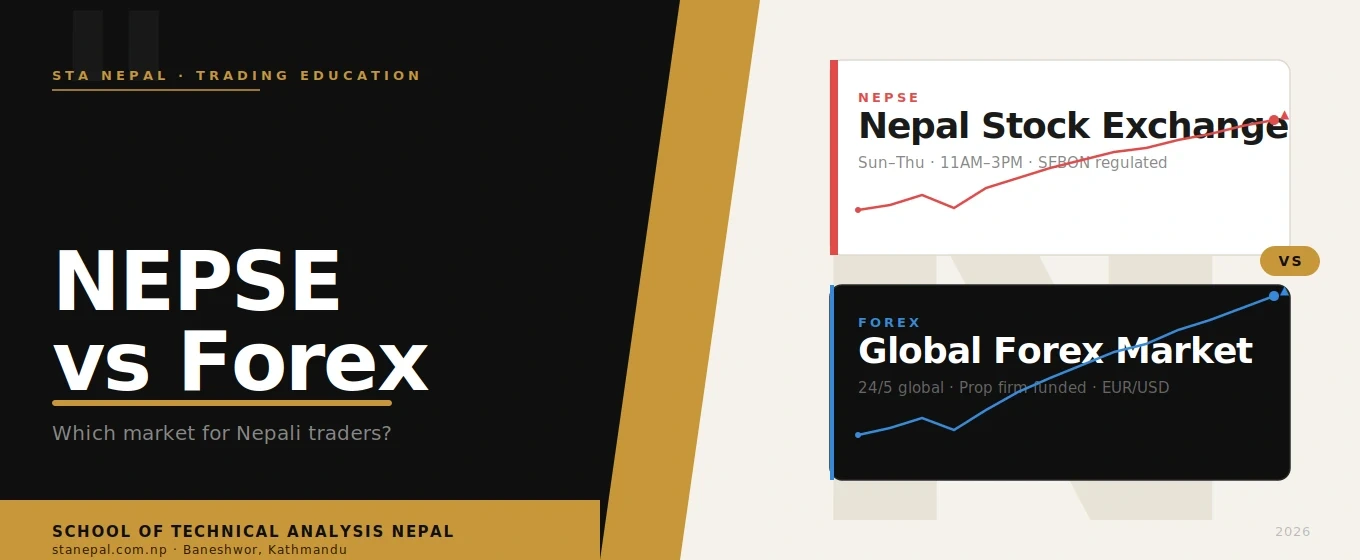
If you've ever asked a Nepali trader "should I start with NEPSE or go straight to forex?", you've probably got two completely different answers. Both markets have created successful traders in Nepal. Both have also wiped out beginners who jumped in without proper education.
This guide cuts through the noise. We'll compare NEPSE and FOREX trading across every dimension that actually matters - capital requirements, trading hours, earning potential, regulatory clarity, and which market suits your personality and goals.
By the end, you'll have a clear picture of which path makes more sense for you - and exactly what knowledge you'll need before putting a single rupee at risk.
What Is NEPSE Trading?
Understanding Nepal's stock market
Nepal's only stock exchange, the Nepal Stock Exchange (NEPSE), is headquartered at Singha Durbar Plaza, Kathmandu. As of 2026, it lists 263 companies with a market capitalization of approximately रू 465,698 crore (around US$34 billion).
Key facts to cover:
- NEPSE trades Sunday–Thursday, 11:00 AM–3:00 PM (Nepal time)
- Regulated by SEBON (Securities Board of Nepal)
- Instruments: equities, mutual funds, debentures
- You trade in NPR - no currency conversion needed
- Requires a DEMAT account with a licensed broker
- Short-term capital gains tax: 7.5% on profits within one year
Who it's for: Investors who want to participate in Nepal's domestic economy, invest in local banks, insurance companies, and hydropower companies, and prefer a regulated, rupee-denominated market.
What Is Forex Trading?
Forex (foreign exchange) is the world's largest financial market, trading over $7.5 trillion per day. Nepali traders access it through internationally regulated brokers like Exness, Pepperstone, or XM.
- Forex trades 24 hours a day, 5 days a week (Monday–Friday)
- Regulated globally (FCA, CySEC, ASIC) - not locally by NRB for retail traders
- Instruments: currency pairs (EUR/USD, GBP/USD, USD/NPR-adjacent pairs), gold, indices
- You need USD (or equivalent) to fund an account - payment via international methods
- Popular frameworks in Nepal is ICT SMC Trading Nepal: ICT (Inner Circle Trader), SMC (Smart Money Concepts)
- No formal Nepal-specific regulation for retail forex, but trading through licensed international brokers is legal
Who it's for: Traders who want global market access, are comfortable with higher leverage, and are targeting prop firm funding rather than equity investing.
Earning Potential - Where Can You Actually Make More?The honest truth about income in both markets
This is the question every Nepali trader really wants answered.
NEPSE potential:
- Returns depend heavily on market cycles; NEPSE index has seen both 100%+ bull runs and 50%+ crashes
- As a retail investor, you're limited to your own capital - there's no external funding
- Consistent annual returns of 15–25% are realistic for skilled NEPSE traders
- Dividend income adds a passive layer
Forex / Prop firm potential:
- With a prop firm account of $100,000 (e.g. FTMO), even a conservative 5% monthly return = $5,000/month (approximately Rs 665,000)
- The key: prop firms provide *their* capital, so you're not limited by your own savings
- This is exactly why prop firm trading has exploded in Nepal - it levels the playing field
- Risk: prop firm rules are strict (daily drawdown limits, profit targets). You lose the account if rules are violated
The STA Nepal angle: This is why STA focuses on prop firm preparation. We teach students not just how to trade, but how to pass funded account evaluations - so they can trade with $10,000–$200,000 in capital they didn't have to save up themselves.
Risk Profile - Which Market Is More Dangerous?
Understanding the risk in each market
NEPSE risks:
- Market manipulation is a known concern in illiquid counters
- Bull run FOMO often causes retail losses (2021 NEPSE crash is a cautionary tale)
- Fundamental analysis still underdeveloped among many retail participants
Forex risks:
- High leverage = high risk if used without proper risk management
- Scam brokers and Ponzi schemes have targeted Nepali traders (always verify regulation)
- Prop firm account blown = reset fee of $100–$500 (not catastrophic, but costly without education)
Verdict on risk: Forex is not inherently more dangerous than NEPSE - it's more dangerous *without education*. A trained trader with proper risk management (1–2% risk per trade, defined stop losses) can manage forex risk very effectively. NEPSE without discipline can be equally damaging.
Who Should Choose NEPSE?
You're a better fit for NEPSE trading if:
- You want to stay in a fully NPR-denominated, locally regulated market
- You're interested in long-term wealth creation through Nepali equities
- You want to understand and invest in local banks, hydropower, and insurance sectors
- You prefer investing over active day trading
- You have a longer time horizon (1–5 years+)
- You're comfortable with SEBON oversight and a formal DEMAT account process
Recommended first step: Take STA's Professional Stock Market Course for NEPSE - a 6-week structured program covering market basics, technical analysis, and risk management specific to Nepal's stock market.
Who Should Choose Forex?
You're a better fit for forex trading if:
- You want 24/5 market access and global opportunities
- You're targeting prop firm funding to trade with larger capital
- You're serious about making trading a primary or secondary income source
- You're willing to invest 3–6 months learning ICT/SMC concepts properly before risking real money
- You're comfortable with international brokers and USD-based accounts
Recommended first step: Join STA's Professional Prop Trading Mentorship class - covering ICT concepts, SMC, risk management, and hands-on funded account preparation with direct mentor feedback.
Yes - and many of STA Nepal's advanced students do exactly this. Here's the typical progression:
1. Learn technical analysis fundamentals (applies to both markets)
2. Start with NEPSE to build discipline in a familiar, NPR-denominated environment
3. Transition to forex once fundamentals are solid
4. Pursue prop firm funding to scale capital without personal financial risk
5. Use NEPSE investments as a long-term portfolio while forex generates active income.
The skills transfer directly. Candlestick reading, support/resistance, risk management - these are universal. The markets are different, but the disciplined trader mindset is the same.
Legal Clarity - Is Forex Trading Legal in Nepal?
This is one of the most common questions we receive. Forex regulations in Nepal continue to evolve. Before participating in forex trading, traders should review the latest guidance from Nepal Rastra Bank (NRB) and seek professional advice regarding compliance and taxation.
Nepal Rastra Bank (NRB) governs all currency-related activities under the Foreign Exchange (Regulation) Act, 1962. Individual traders using platforms like Exness (FCA/CySEC-regulated), Pepperstone, or XM are operating legally. Profits must be declared as taxable income.
What is *not* legal: using unlicensed local operators, unregulated brokers, or operating forex-related businesses without proper registration.
Note: Always use internationally regulated brokers. If a broker promises guaranteed returns or operates without regulatory oversight - avoid them entirely.
Conclusion: The STA Nepal Recommendation
There's no single "right" market. There's only the right market *for you*, at the right time, with the right education.
If your goal is long-term wealth through Nepali equities - start with NEPSE. Learn the market, understand Nepal's economic sectors, and build patient capital.
If your goal is active trading income and you're willing to invest seriously in education - forex and prop firm trading offers the highest earning potential available to Nepali traders today, without requiring large personal capital.
Either way, the common thread is education. Jumping into either market without proper training is the fastest way to lose money. STA Nepal has trained 5,000+ students across both paths - and we've seen firsthand that the traders who succeed are the ones who learned before they earned.
The right market isn't the one with the biggest promises-it's the one that aligns with your goals, risk tolerance, and commitment to learning.
If you'd like structured guidance before risking real money, explore STA Nepal's training programs or attend one of our free introductory webinars to understand which path suits you best.
Learn NEPSE Trading
Explore Prop Trading Mentorship
Join a Free Webinar
Frequently Asked Questions (FAQ)
Q: Is NEPSE or forex better for beginners in Nepal?
A: NEPSE is generally more accessible for beginners due to NPR denomination and local regulation. However, with proper education, forex and prop firm trading offer significantly higher income potential. Both require structured learning before investing real money.
Q: Is forex trading legal in Nepal in 2026?
A: Yes. Forex trading is legal in Nepal when conducted through internationally regulated brokers. Profits must be declared as taxable income under Nepali law.
Q: How much capital do I need to start forex trading in Nepal?
A: Most international brokers allow accounts from $100–$500. However, many Nepali traders start forex through prop firm challenges, which require a one-time fee ($100–$500) and let you trade with $10,000–$200,000 of the firm's capital if you pass the evaluation.
A: NEPSE operates Sunday to Thursday, from 11:00 AM to 3:00 PM Nepal time.
A: Absolutely. Many experienced Nepali traders use NEPSE for long-term portfolio growth and forex for active income. The technical analysis skills - chart reading, risk management, price action - transfer directly between both markets.
School of Technical Analysis
0 comment